Is shellac kosher? Most major North American agencies, including the OU and Star-K, accept shellac, sold on labels as confectioner’s glaze or E904, following Rav Moshe Feinstein. Israeli mehadrin hechsherim generally do not, so the answer depends on the standard your home keeps and on the hechsher printed on the package.
What Shellac and Confectioner’s Glaze Actually Are
Shellac is a resin. A tiny scale insect called the lac bug (Kerria lacca) feeds on tree sap in India and Southeast Asia and leaves a hard resin crust on the branches. Workers collect those encrusted twigs, and the resin is dissolved in alcohol, heated and filtered to strip out the natural red dye, bark and insect fragments. What is left is dried into flakes and later mixed again with alcohol so it can be sprayed onto food. The Star-K’s account of the process walks through each of those steps.
When the same material goes on candy, the ingredient panel usually calls it confectioner’s glaze. You may also see resinous glaze, pure food glaze, natural glaze or pharmaceutical glaze on vitamins and tablets. In Europe and on many imported products the code is E904. All of these names point to the same lac resin, sometimes blended with other coating ingredients.
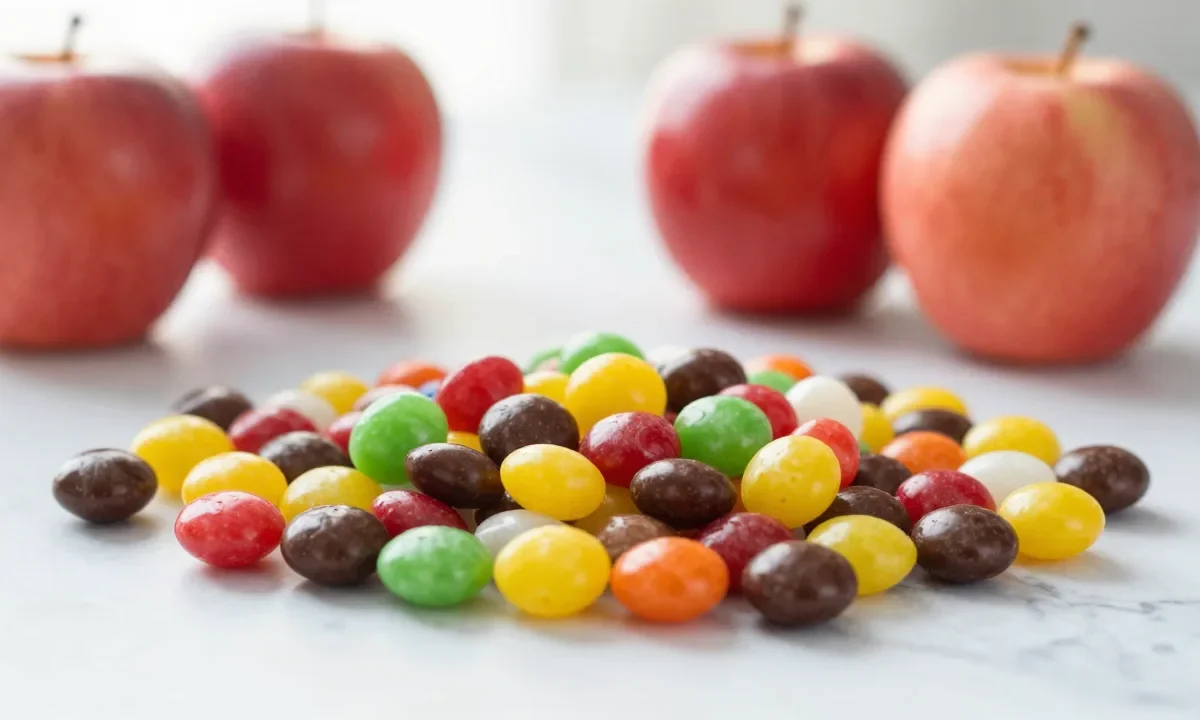
Its job is cosmetic and protective. A whisper of glaze gives jelly beans, candy corn and chocolate-panned candies their shine and keeps them from sticking together or picking up moisture. The OU’s Halacha Yomis note describes the layer as roughly a thousandth of an inch thick. That thinness turns out to matter a great deal in the halachic discussion.
Why Most American Agencies Accept Shellac
The lenient position goes back to Rav Moshe Feinstein in Igros Moshe (Yoreh De’ah II:24). The insect itself is not kosher, so the question is whether something it produces shares that status. Rav Moshe compared lac resin to bee honey, which the Torah permits even though bees are forbidden. He also pointed out that hardened shellac has no food value, no taste and no color, that it is mixed with about four parts alcohol to one part resin during processing, and that it serves only as a protective coating rather than as food.
Star-K states plainly that it is its policy to follow Rav Moshe and permit confectioner’s glaze. The OU’s late posek Rav Yisroel Belsky agreed, and the OU’s longer halachic discussion explains his main reason: shellac is a waste product of the insect, and it is unfit to eat (nifsal mei’achila), the same logic used for beeswax. A second reason the OU cites is the tiny amount involved, because a coating that thin is considered nullified on the surface of the candy.
In practice, that means a candy certified by one of the large American agencies can list confectioner’s glaze on the label and still carry the agency’s symbol without contradiction. The glaze does not undermine the hechsher. If anything, it is one of the ingredients the agency already reviewed before printing its mark on the package.
Where Views Differ: Rav Elyashiv and Israeli Hechsherim
Not everyone accepts that reasoning. Rav Yosef Shalom Elyashiv questioned the permit, arguing that even though shellac is inedible, it should take the status of the insect it comes from. The insect is also inedible, the argument goes, and the Torah still forbids it. The Minchas Yitzchak, while engaging with Rav Moshe’s logic, also leaned toward avoiding shellac-coated foods.
That stricter view shapes kashrus in Israel. An overview on Yeshiva.co notes that none of the mehadrin Israeli hechsherim accepts shellac, and that Israeli certifiers monitor which coatings are used on produce sold under their supervision. The same piece observes that Rav Moshe’s approach has been accepted by most major hechsherim in North America, and it frames the gap as two legitimate traditions following their own course.
So this is a genuine machlokes, not a question of one agency being careful and another careless. If your family follows Rav Elyashiv’s rulings, or you only eat under an Israeli mehadrin or Badatz standard, a glazed American candy may not fit your practice even with a solid hechsher on it. Our guide to what mehadrin and Badatz mean explains how those higher tiers work. Communities differ here, so ask your rav which standard your home keeps.
Take a photo of the product and KosherCheck checks it against your standards in seconds, with the reasons why.
Where Shellac Hides on the Shelf
Candy is the obvious place. Glossy jelly beans, candy corn, chocolate-covered raisins and malted balls, mint cremes and many panned chocolates rely on a glaze for that finished shine. If a candy looks lacquered, the ingredient list is worth a second look.
Shellac also turns up in less obvious spots. It is used on some coffee beans, in chewing gum and on vitamins, supplements and tablets, where it may be listed as pharmaceutical glaze. On imported snacks and sweets from Europe, look for E904 in the additives. Our kosher E-numbers list groups E904 with the other glazing agents, beeswax (E901) and plant-based carnauba wax (E903), so you can tell them apart at a glance.
Fresh produce is the other big category. Apples, citrus and some other fruits are often waxed after washing to replace their natural bloom. According to the Star-K’s guide to fruit and vegetable waxes, the three main bases are shellac, carnauba and petroleum waxes. Star-K’s conclusion is that, following the majority of what is used, a consumer need not be concerned with vegetable, petroleum or shellac based waxes on fruits and vegetables. Those who follow the stricter Israeli practice sometimes choose unwaxed fruit or peel it, which is a question for your rav.
How to Check a Glazed Candy
The first thing to check on a shiny candy is not the glaze. It is the hechsher. Confectioner’s glaze is only one ingredient, and the bigger risks in candy are usually gelatin, carmine (E120, which is also insect based), dairy ingredients and flavorings. A candy with a reliable symbol has had all of those reviewed together. A candy with no symbol is a question mark no matter what the glaze is made of.
- Look for the hechsher on the package first, and note any D or DE next to it.
- Read the ingredients for confectioner’s glaze, resinous glaze, shellac or E904.
- Scan for gelatin, carmine or cochineal, which are separate concerns.
- Check the country of manufacture, since formulas and certification vary by country and factory.
- If you keep the stricter view on shellac, set aside glazed items even when certified.
Carmine is the ingredient people most often confuse with shellac, since both come from insects. They are treated very differently. Our article on whether carmine (E120) is kosher explains why the red dye is a far bigger problem than the glaze.
When you are standing in a store with a bag you do not recognize, you can take a photo of the product with KosherCheck. It picks out the hechsher, reads the ingredient list and flags things like confectioner’s glaze or E904 against the standards you set, including whether you want shellac treated as acceptable. The symbol on the package is still what counts, and rulings belong to your rav, but it saves you from squinting at tiny print.
Shellac, Pills, Passover and Travel
Vitamins and medications raise a separate set of questions. Medicine that is swallowed without taste is often treated more leniently than food, and many people take a coated pill without a second thought. Because the rules for medication depend on the person’s health and situation, this is one place to ask your rav directly rather than relying on a general article. Never stop a prescribed medication over a coating without speaking to your doctor and your rabbi.
For Passover, the glaze itself is not the main issue. A candy that is fine all year can still contain chametz or kitniyot from other ingredients, or be made on equipment that is not kosher for Passover. Look for a specific Passover certification on the package during the holiday, not just the year-round symbol.
Travel adds a twist. Candy certified in Israel by a mehadrin agency is unlikely to contain shellac at all, while American candy under a major agency may well include it. If you are buying sweets abroad, or bringing American candy to hosts who keep the Israeli standard, read the label and ask what they hold by. When you want a second pair of eyes on an unfamiliar package overseas, you can scan the product with KosherCheck and then confirm the hechsher with the agency’s own site.
Frequently asked questions
KosherCheck offers informational guidance and detects certifications and ingredients. It is not a halachic ruling. For a final decision, consult your rabbi.