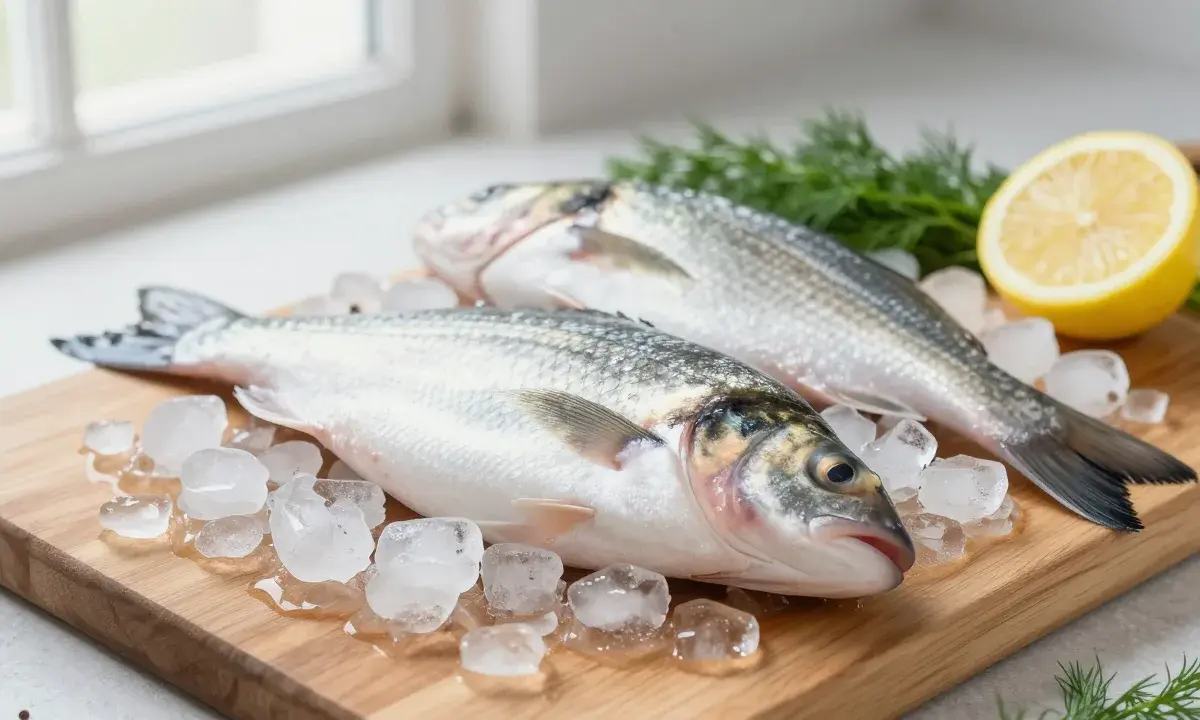
Kosher fish must have both fins and scales, and the scales have to be visible and come off without tearing the skin. Salmon, cod, tuna and tilapia pass, while catfish, shark, swordfish and all shellfish do not. Once fish is filleted, canned or smoked, the scales are gone, so a reliable hechsher becomes the way you know.
The Rule in One Sentence: Fins and Scales
The Torah gives the test for fish in a single verse: whatever lives in the water and has fins and scales may be eaten (Leviticus 11:9). Everything else that swims, crawls or clings to the sea floor is off the table. That is the entire biological test. There is no slaughter, no salting and no special blessing involved, which is why a kosher fish is far simpler than kosher meat.
The Talmud adds a practical shortcut that every kosher shopper learns early. Any fish that has kosher scales also has fins, so in practice we look for the scales. The reverse is not true. Catfish has fins but no scales, and that alone makes it non-kosher.
This is the first rule many kosher shoppers learn at the fish counter: find the scales, and the fins take care of themselves. It is also why so many kosher questions about fish come down to one detail, whether the scales are real kosher scales or something that only looks like them. The next section covers exactly that.
What Counts as a Kosher Scale
Not every bumpy skin qualifies. According to the guidance summarized by Chabad’s guide to kosher fish, a kosher scale has to be visible to the naked eye and easy to remove from the skin, by hand or with a tool, without tearing the skin underneath. A fish needs only a few such scales to count.
Biologists sort fish scales into types, and Chabad’s piece on which scales make a fish kosher shows how they line up with the halacha. Most bony fish have thin, overlapping scales that lift off easily, and most of those fish are kosher. Shark skin is covered with tiny thorn-like structures that do not come off, so shark is not kosher. Sturgeon has hard, plate-like scales that cannot be removed without damaging the skin, so sturgeon and its caviar are not kosher.
A few details surprise people. Tuna has very few scales, yet it is kosher. A fish that sheds its scales when it is caught is still kosher if it had them in the water. Swordfish loses or embeds its scales as it matures, and the common practice is to treat it as non-kosher. If you ever catch an unfamiliar fish, the classic home test is to pick at a scale and see whether it peels off cleanly. For anything borderline, ask your rav.
Common Fish That Pass, and Why Shellfish Never Do
Here is a short list to keep in mind at the store. These are generally kosher species: salmon, trout, cod, flounder, bass, snapper, grouper, tilapia, carp, pike, perch, whitefish, herring, mackerel, many sardines and many species of tuna.
These are not kosher: catfish, eel, shark, swordfish and sturgeon. Some species are tricky because a common name covers several different fish, so a name on a menu is not proof. Chabad, for example, lists freshwater cod as non-kosher, even though true cod passes.
Shellfish are the easy part. Shrimp, prawns, lobster, crab, clams, mussels, oysters, scallops, squid and octopus have no fins and no scales at all, so they never pass, no matter how they are prepared. The same applies to whales, which are not fish in the first place. If you want the bigger picture of which foods fall into the forbidden category, our guide to what treif means walks through it.
One practical warning: imitation crab and seafood salads look harmless, but many are built on blended fish paste plus flavorings. Look for a reliable hechsher on the package and read the ingredient list for crab or shellfish extract before you assume anything.
Take a photo of the product and KosherCheck checks it against your standards in seconds, with the reasons why.
Buying Fresh Fish and Fillets
Once the skin is gone, so is the evidence. Most kosher agencies follow a rabbinic rule that a skinless fillet may not be eaten unless a Jew has confirmed it came from a kosher fish. The STAR-K fresh fish policy spells out how that plays out at the counter.
In a store under reliable supervision, fish is filleted with a mashgiach present, so any fillet there is fine. Skinless fillets from an unsupervised store, or ones not sealed in a package with a reliable kosher symbol, are not acceptable. STAR-K is clear that color alone is not a sign. The pink of salmon does not prove the fillet is salmon.
There are a few workable options. Fish sold with the skin and scales still on, packaged by a commercial fish company rather than cut in the store, can be bought without concern under that policy. You can also buy a whole fish and cut it at home. Watching an unsupervised fish store fillet a whole fish on cleaned knives and boards is technically possible, but STAR-K discourages it unless there is no other choice, and a rav should weigh in.
Before you leave the counter, check the label on any packaged fish for a hechsher. A quick photo with KosherCheck can help you see whether the symbol on a package matches the agencies you rely on.
Canned, Smoked and Pickled Fish: Why the Hechsher Matters
Processed fish is where the fins and scales rule meets real factories. Canned tuna, lox, smoked whitefish, pickled herring and sardines in oil have all lost the skin you would need to identify the species. Chabad’s article on whether tuna is kosher notes that substituting one fish for another is common in the industry, and says canned, smoked, pickled or otherwise processed tuna needs reliable certification.
The species is only the first step. OU Kosher describes in how it certifies fish products that enough skin must remain for its field representative to confirm the species, the plant must not cross-contaminate with non-kosher fish, every additive must be approved, and the process itself must be reviewed. Smoked and pickled fish can include wine, flavorings, colorings or oils, and canning lines may run other products.
Agencies also differ on cooking questions. COR’s article on kosher considerations in canned tuna explains that some agencies require a Jew to start the cooking process, while others hold canned tuna does not need that, and both kinds of tuna are on store shelves. If that distinction matters in your home, ask your rav which standard to follow. In every case, look for the hechsher on the can or vacuum pack itself, because formulas and certification vary by country and factory.
The F on the Label, Fish With Meat, and the Worm Question
Fish is pareve, so it can be eaten with dairy, which is why lox and cream cheese is a classic. Our guide to meat, dairy and pareve explains the categories. There is one catch: Jewish law treats eating fish together with meat as something to avoid for health reasons, so many people keep separate plates and eat or drink something in between. Customs vary, so follow your family and your rav.
That custom is why you may see an F next to a symbol. OU Kosher explains in its list of OU symbols that OU-F marks a product with fish ingredients that should not be eaten or cooked with meat. The F depends on the ratio. If the other ingredients are less than 60 times the fish, the product gets OU-F, which is why one OU Worcestershire sauce with anchovies carries an F and another does not. When the fish is obvious, as in tuna salad, the label may just say OU. Our post on kosher certification letters covers D, M and P too.
Finally, the anisakis worm question. Some wild fish, such as wild salmon, can carry these parasites. STAR-K advises avoiding certain wild-caught fish over this concern, while the OU, in its canned salmon FAQ, says it does not require checking for them. Communities differ, so ask your rav. If you want a quick read on a can or pack while you shop, KosherCheck can scan the product and flag it against the standards you set.
Frequently asked questions
KosherCheck offers informational guidance and detects certifications and ingredients. It is not a halachic ruling. For a final decision, consult your rabbi.